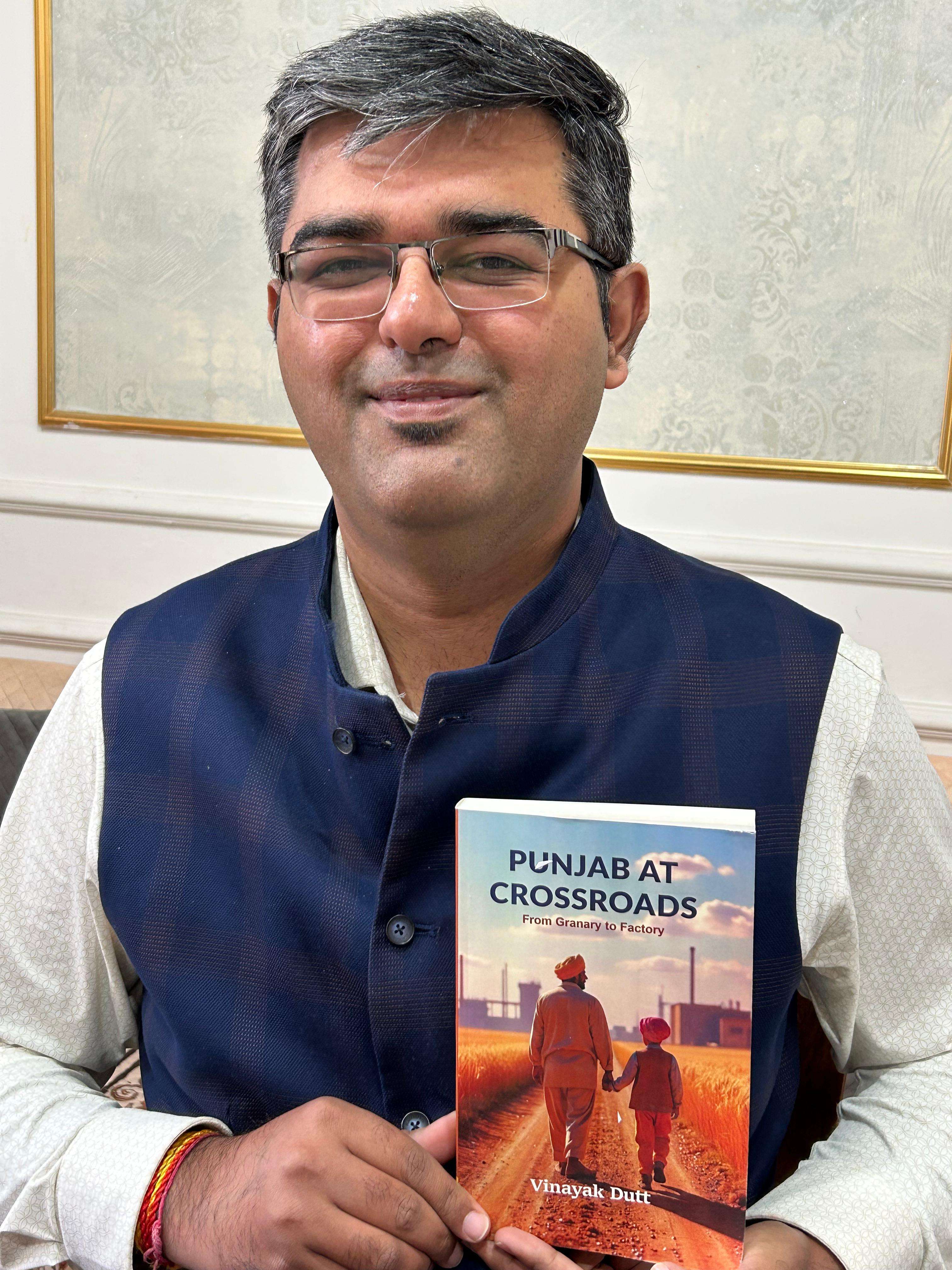
Chandigarh, Punjab: At a time when Punjab is confronting economic uncertainty, youth migration, agricultural distress, and industrial stagnation, Punjab at Crossroad: From Granary to Factory has emerged as a timely and thought-provoking book examining the state’s evolving economic identity and future direction. Written by author and communication strategist Mr. Vinayak Dutt, combines historical analysis, policy understanding, and contemporary realities to explore the structural challenges and opportunities shaping Punjab today.
Structured across 11 chapters, Punjab at Crossroad: From Granary to Factory presents a detailed journey through Punjab’s economic transformation tracing its past, assessing present challenges, and proposing a framework for sustainable growth and rather than viewing Punjab solely through its agricultural legacy, argues that the state now stands at a decisive crossroads where industrial diversification, innovation, and balanced development have become increasingly important.
The book begins by examining Punjab’s colonial economic history and the limited industrial foundation laid during British rule. While regions elsewhere developed manufacturing ecosystems, Punjab was strategically shaped as an agrarian centre serving imperial food requirements. Canal colonies and agricultural expansion strengthened farming but simultaneously restricted indigenous industrial growth, creating a long-term dependence on agriculture.
A significant portion of the book explores the economic impact of Partition, describing 1947 not only as a humanitarian tragedy but also as a major industrial disruption. With Lahore remaining in Pakistan, Indian Punjab lost its central commercial, manufacturing, and cultural hub, creating an economic setback whose effects continued to influence industrial development for decades.
The book further analyses the growing impact of urbanisation on Punjab’s agricultural landscape. Expanding urban centres including Ludhiana, Jalandhar, and Amritsar are increasingly absorbing fertile agricultural land, raising concerns around shrinking cultivation areas, ecological stress, and long-term sustainability.
Another important discussion within Punjab at Crossroad: From Granary to Factory centres on agrarian distress and farmers’ mobilisation. Rather than approaching these developments purely through politics, the book evaluates them as indicators of deeper structural concerns including declining farm profitability, groundwater depletion, debt pressures, and rural economic insecurity and also addresses Punjab’s evolving labour and industrial ecosystem. The book identifies a dual challenge: the migration of skilled youth abroad and increasing industrial dependence on migrant labour for manufacturing and textile sectors highlighting how these shifts influence productivity, workforce stability, and social dynamics.
Among the book’s most distinctive insights is its chapter on Punjab’s music industry. Presented as a culturally rooted and organically developed success story, the sector is explored as an example of employment-generating and globally connected growth. From production studios and live performances to digital platforms and creative entrepreneurship, the industry reflects how Punjab’s cultural capital can contribute to economic diversification.
Author Mr. Vinayak Dutt, known for his work across journalism, communication strategy, and socio-political research, brings years of engagement with governance, public narratives, and policy discussions into the book’s framework. His professional experience in communication, research, and campaign strategy shapes the book’s analytical and grounded perspective.
Speaking about the central message of the book, Mr. Vinayak Dutt said:
“Punjab’s future cannot depend only on its agricultural legacy. Economic growth, employment opportunities, industrial development, and social stability must progress together. The state possesses strong entrepreneurial energy and cultural strength, and the conversation now should focus on creating sustainable pathways for long-term development.”
More than an economic commentary, Punjab at Crossroad: From Granary to Factory positions itself as a research-driven and policy-oriented contribution to discussions around Punjab’s next decade encouraging readers, institutions, and policymakers to reflect on the choices that may define the state’s future.
About the Book
Punjab at Crossroad: From Granary to Factory examines Punjab’s economic history, agricultural dependence, industrial challenges, labour dynamics, urbanisation, cultural industries, and future development opportunities. Through historical research and contemporary analysis, the book presents a broader understanding of Punjab’s transition and advocates for a diversified and sustainable growth model.
About Mr. Vinayak Dutt
Mr. Vinayak Dutt is an author, communication strategist, and researcher whose work focuses on public communication, socio-political narratives, and brand building. His expertise lies in communication and strategic storytelling developed through years of engagement with journalism, governance communication, research, and campaign strategy. He has worked with governments, political stakeholders, and institutions across various capacities while contributing to discussions on politics, agriculture, sociology, history, and public affairs.