How Dishant Kharbanda’s two-decade journey through education, technology, and a global pandemic produced one of the year’s most unexpected debuts
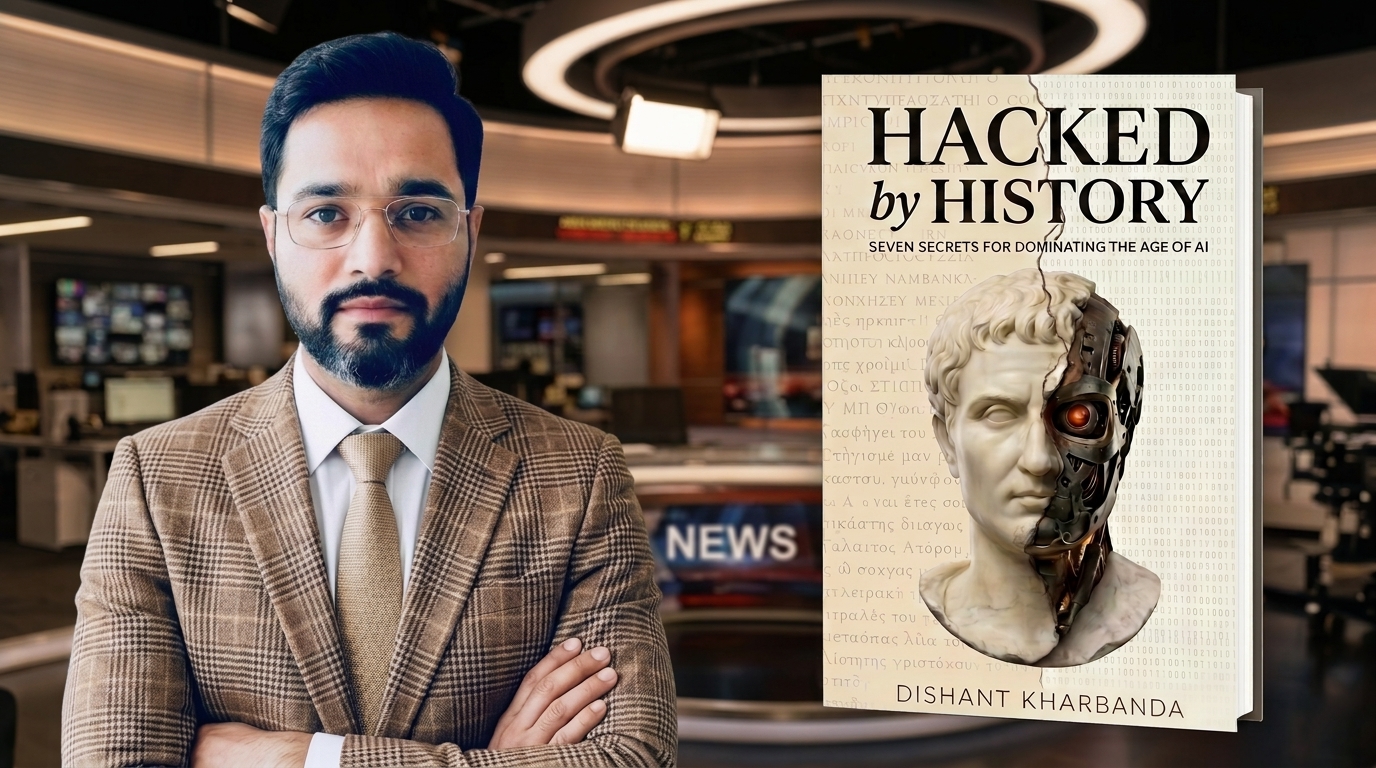
In the crowded landscape of books about artificial intelligence — where titles compete to predict, warn, or instruct — a debut from an Indian edtech entrepreneur has taken an approach that few in the publishing world expected. Rather than writing about what AI can do, Dishant Kharbanda has written about what humans must become. And he has done it by looking not forward, but three thousand years back.
Most entrepreneurs who have built, scaled, and exited a company in the education technology space would spend the next chapter of their career doing something similar. Perhaps a second startup. Perhaps advisory work. Perhaps the conference circuit.
Kharbanda did all of that. And then he wrote a book about Socrates, Viktor Frankl, and a swordsman who won sixty-one duels with a quality of attention that most people have never experienced for five consecutive minutes.
The builder’s path
His first major venture was an edtech platform that operated at global scale, a B2B provider reaching institutions across more than 120 countries. Under his leadership, it grew to become one of the world’s top 30k web portals. The company was awarded Most Innovative Edtech Enterprise by India’s then Union Minister for Human Resource Development in 2013, a recognition that cemented Kharbanda’s reputation as a builder who understood both the technology and the sector it served.
After taking his exit, he could have repeated the formula. Instead, he went back to school. The Advanced Executive Programme in Artificial Intelligence at IIM Calcutta. He earlier studied Fundamentals of Pedagogy at the University of Helsinki. Each one adding a layer to a question that had been forming since his earliest days in edtech: what happens to education — and to the human beings it serves — when machines can do the things we have always trained people to do?
What makes Kharbanda’s profile unusual is the combination. He is not purely an academic, though his collaboration with Emeritus Professor David Faulkner — former Director of the MBA and co-founder of the Saïd Business School at the University of Oxford — as Deputy Programme Architect of the Socratic Fellowship gives him deep academic credibility. He is, in his own description, someone who has spent twenty years oscillating between building technology and asking why. The book is the product of the asking.
Why history?
The decision to write about ancient history rather than contemporary technology was deliberate and, Kharbanda acknowledges, counterintuitive.
“There is an enormous amount of noise around AI,” he says. “Every week brings a new tool, a new benchmark, a new prediction. Very little of it will matter in five years. The question I was interested in was: what has always mattered? What capacities have survived every disruption in human history? If you can identify those, you have something that is genuinely useful — not for this quarter, but for the next fifty years.”
The seven figures he selected — Socrates, Miyamoto Musashi, Copernicus, Viktor Frankl, Homer, Lao Tzu, and Genghis Khan — are chosen not for their fame but for what each reveals about a specific human capacity under extreme pressure.
“There is an enormous amount of content about what AI can do,” he has said. “What is missing is a serious conversation about what humans must do. Not in response to AI. In preparation for a world in which the things we have always relied on to make us valuable — knowledge, expertise, cognitive speed — are no longer ours alone.”
This framing — “preparation” rather than “reaction” — gives the book a quality that most AI-adjacent literature lacks: calm. There is no panic here. No breathless prediction. No techno-utopianism and no doomerism. The tone is closer to a long conversation with someone who has thought carefully and wants to share what they have found.
The writing style owes a conscious debt to Yuval Noah Harari, and Kharbanda is open about the influence. “Sapiens showed me that a book about history could be a book about the future. That the past is not something behind us. It is something underneath us — the foundation on which everything we do next will be built.”
What comes next?
Kharbanda is already working on a second book and academic frameworks, this one focused on making artificial intelligence genuinely accessible to non-technical readers. He describes it as a response to a gap he has observed throughout his career: the conversation about AI is either too tool-specific, targeting developers and engineers, or too sweeping and philosophical, leaving the general reader overwhelmed. The next book aims to occupy the middle ground — a clear, honest, jargon-free guide to what AI actually is, what it can do, and what it means for the person reading it.
In the meantime, Hacked by History stands on its own as something increasingly rare in the AI conversation: a book that steps back far enough to see the full picture. The technology is moving fast. The human questions underneath it have been here for three thousand years.
“The future does not belong to technology,” Kharbanda writes in the book’s prologue. “It belongs to the human being who picks it up.”
In the words of Professor Faulkner (Oxford) — “I couldn’t put it down. It is utterly brilliant. I can honestly say it is the best social philosophical mini-treatise I have ever read.
Hacked by History: Seven Secrets for Dominating the Age of AI by Dishant Kharbanda is available now.
For more information visit: https://dishantkharbanda.com/
To buy the book: https://dishantkharbanda.com/books/hacked-by-history